


At Symbio, our experience with clinical trials runs deep and so do our insights. We’ve experienced a lot over the decades about what it takes to manage clinical trials and we’ve compiled these learnings to share with you.
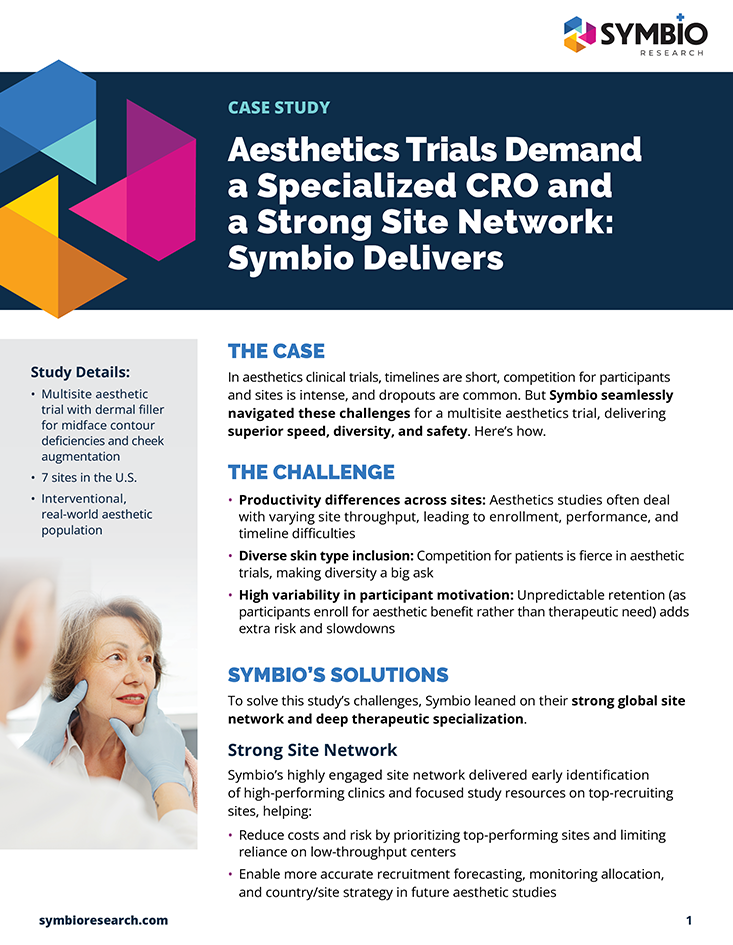
Aesthetics Trials Demand a Specialized CRO and a Strong Site Network: Symbio Delivers
In a competitive, multi-site dermal filler trial, Symbio combined therapeutic expertise and a high-performing network to deliver on-time recruitment, strong diversity, and an excellent safety profile—proving the value of a specialized aesthetics CRO.
How Symbio Delivered Fast Recruitment & High Retention in a Global Phase 3 Psoriasis Trial
In this global Phase 3 moderate-to-severe plaque psoriasis trial, Symbio delivered rapid recruitment, strong retention, and exceptional startup efficiency across 30 sites. With 404 patients randomized in just ~4.2 months, a ~92% randomization rate, and ~94% patient retention, the program stayed on track despite strict eligibility criteria and ambitious timelines. See how specialized dermatology expertise made the difference.
Navigating Phase II and Phase III Clinical Trials in the US and EU: Trends, Challenges, and Best Practices
Phase II and Phase III clinical trials are critical to regulatory approval—but navigating them across the U.S. and EU introduces added complexity. This white paper explores the evolving regulatory landscapes, operational challenges, and methodological innovations shaping late-stage clinical development in both regions. It provides practical guidance on trial design, regulatory strategy, patient recruitment, data quality, and best practices to help you execute global Phase II/III programs efficiently, compliantly, and with confidence.

Design of Experiment and Statistical Analysis in Dermatology and Aesthetic Trials

Rare Skin Diseases: Design of Experiment and Statistical Analysis
Rare skin diseases, characterized by their low prevalence and diverse manifestations, present significant challenges in understanding their causes, progression, and treatment. These diseases come with challenges such as proper diagnosis, management, treatment and research. Rare skin diseases have a diverse range of conditions that affect a small percentage of the population. This paper dives deeply into the challenges, advance in diagnosis, along with the management and research involved with Rare Skin Diseases. Additionally, exploring the application of design of experiments (DoE) and statistical methodologies to address these challenges effectively.

Prurigo Nodularis
Prurigo Nodularis is a disease that causes extreme itch in those afflicted. PN is a chronic disorder that manifests as pruritic lesions throughout the body, taking the form of papules, plaques, and nodules.
This white paper will delve into the various aspects of PN, including who is affected by PN, the etiology, quality-of-life burden, treatment, and current unmet medical needs, as well as what future treatments are on the horizon. The surge in new and emerging treatments has led to a significant boost in the PN clinical research scene. This paper will also address the challenges in executing and managing a PN study.

An Introduction to Botulinum Toxin: Clinical Science and US Regulation
This white paper provides an overview on botulinum toxins, including their mechanism, their clinical use, their regulation in the United States, and best practices for conducting clinical trials for these products. This paper can serve as both a great introduction to the topic and as a general refresher for those already familiar with botulinum toxin.

Urticaria Overview and Clinical Research Considerations
Urticaria is a highly prevalent inflammatory skin disorder, typically presenting as itchy wheals of various sizes, accompanied by erythema of the surrounding skin. There are two currently known drivers of CSU pathogenesis: autoallergy with IgE autoantibody involvement, and autoimmunity with IgG autoantibody involvement. For all chronic urticaria, the standard first-line treatments are second generation H1 antihistamines.
From a pathological standpoint, the different subtypes of CU are inadequately defined and lack reliable diagnostic biomarkers, making the design of more targeted therapeutic agents difficult. Improved efforts in pathology research and drug development are needed to meet the needs of CU patients across the world. This white paper discusses how to overcome common challenges in clinical research for Urticaria therapies.
Industry and Clinical Trends in Dermal Fillers
Dermal fillers are aesthetic devices that can be injected permanently or non-permanently to restore volume and aesthetic appearance to a particular area of the body. They have become increasingly popular because they are effective and non-invasive options for facial rejuvenation. Increased demand for filler treatments in the coming years will provide considerable financial incentive for the development of safer, cheaper, and better products.
White Paper Request
"*" indicates required fields